
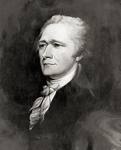
Hamilton
Alexander Hamilton was a delegate to the Constitutional Convention. Along with John Jay and James Madison, Hamilton authored an important work, The Federalist Papers, that argued for ratification of the new Constitution. He brought to the convention his own draft version of a constitution, including qualifications for president that we look at here.
While it has been abundantly clear in my research that those born in the United States (except the children of ambassadors and invading armies, slaves, and the Indians) were always considered natural born citizens, there has been some question as to whether this extends to those who are citizens at birth by law (such as the children of citizens born overseas). Here we have a statement by a key figure in the debate, and very likely the source of the clause in the constitution we have today, that the intention of the framers, at least this one very influential framer, was that the qualification is “born a citizen”.
Hamilton’s draft constitution was presented late in the process of the convention. We know that the presidential eligibility clause citizenship requirement was also added late in the process.
This is what Hamilton’s draft constitution said:
ARTICLE IX
Sec 1 No person shall be eligible to the office of President of the United States unless he be now a citizen of one of the States or hereafter be born a citizen of the United States.
This was cited by Jill Pryor in her important law review article, The Natural-Born Citizen Clause and Presidential Eligibility: An Approach for Resolving Two Hundred Years of Uncertainty, that is among the Obama Conspiracy Theories Bookmarks (link above) and my thanks goes to various blog posters including nolu chan on Politijab.com who highlighted it.





Yes, but you do know what Orly’s response to this will be.
Hamilton was one of them darn foreigners. He wasn’t even born in this country !
“Alexander Hamilton, later President of the United States, was a delegate to the Constitutional Convention.”
Hamilton was never President. He did found the National Treasury, but he was never President.
That’s a big oops!
Obama sued in small claims court…for $4.90:
http://www.therightsideoflife.com/?p=5564
He’s got no case. No one forced him to write the letter and spend the $4.90.
No one forced him to write the letter
Where’s your proof?
😉
Without being too pedantic: IOW, “natural-born” = “citizen by birth” = by ius soli (from British common law, incorporated as the foundation of U.S. law, and later made explicit by the 14th Amendment), and also by any elements of ius sanguinis that Congress sees fit to enact by statute law. Nothing mysterious here.
Where’s your evidence? 😉
Go back to Latin America with your Latin! 😉
She’s going to call for all $10 bills to be removed from circulation.
The citizen issue gets interesting. Whatever the Constitution says, it was written in an age long before the idea of dual ciitzenship was an accepted reality.
Obama *may* have a valid citizenship here, but by the laws of other nations(particularly Indonesia where he was adoptped by his mother’s new husband) he has citizenship THERE as well. Clearly the founders never anticipated the problems of such potentially divided loyalties.
In effect, my issue isnt about his citizenship here, but rather whether or not he has appropriately renounced any other citizenships or foreign loyalties.
Based on both the laws of the United States (regarding renunciation of citizenship) and the laws of Indonesia which prohibited dual citizenship or the acquisition of Indonesian citizenship by someone whose country didn’t allow renunciation, we can be certain the Obama was never a citizen of Indonesia. Pointers to the Indonesian laws are in my article http://www.obamaconspiracy.org/2009/02/hollister-v-indonesian-citizenship-law/.
As to your second point, we know that President Obama gained Kenyan citizenship and lost Citizen of the UK and Colonies in 1963, acquiring Kenyan citizenship, which he lost when he reached age 21.
While not prohibited by the Constitution, I personally wouldn’t support someone who was currently a dual citizen, nor do I think such a person could be elected as president. It’s one thing to get citizenship through some foreign law in 1948 from a father you hardly knew, but it’s another thing not to make a full commitment to the country you want to lead as an adult.
Dual citizenship was already an issue in the early days where those born in the United Kingdom were UK citizens, even if they moved to the US and became citizens.
It is unlikely that Obama ever got Indonesian citizenship as the laws prohibited such.
The real question is: Has Obama renounced his loyalty to the United States. The evidence suggests strongly that he has not. He returned to live in the US by age 7(?) and continued to live there.
Of course, the courts have since ruled that it requires non trivial positive acts by a US citizen to lose said citizenship. Voting in a foreign country or participating in a foreign country’s government were rejected as sufficient reasons for one to have abandoned one’s birthright.
Nowadays, either an explicit renouncing in front of a US official or serving in a military involved in hostile actions against the US seem to be the few remaining ways to lose one’s citizenship.
A natural-born citizen is a person born of American parents. Thus a person born abroad of American parents, according to the Constitution, would be eligible to the office of President.
“The framers thought it wise, in view of the probable influx of European immigration, to provide that the President should at least be the child of citizens owing allegiance to the United States at the time of his birth.” Alexander Porter Morse, “Natural-Born-Citizen of the United States: Eligibility for the Office of President,” Albany Law Journal, vol.66 (1904), p. 99
http://restoretheconstitutionalrepublic.com/forum/index.php?topic=3900.0
http://restoretheconstitutionalrepublic.com/forum/index.php?topic=3900.0
http://restoretheconstitutionalrepublic.com/forum/index.php?topic=3956.0
END OF STORY.
The snip from Morse, whose entire paper appears unavailable on the Internet is inconclusive. Note the words “at least be the child of citizens”, which implies that there is some greater criteria than being the child of citizens — perhaps being born in the United States.
Based on the comments (and footnotes) of Jill Pryor, it would appear that Morse’s views are being misrepresented when he is enlisted against Barack Obama. http://yalelawjournal.org/images/pdfs/pryor_note.pdf
Pryor begins by saying:
Morse apparently argues in the gray area regarding those born to citizens overseas.
You…
“While it has been abundantly clear in my research that those born in the United States (except the children of ambassadors and invading armies, slaves, and the Indians) were always considered natural born citizens…”
Me…
http://tiny.cc/NotaCitizen
Citizenship of the United States, expatriation, and protection abroad …
By United States. Dept. of State
CALIFORNIA
SEC. 50. Who are the people.- The people, as a political body, consist:
1. Of citizens who are electors.
2 Of citizens not electors.
SEC. 51. Who are citizens.- The citizens of the State are:
1. All persons born In this State and residing within it, except the children of transient aliens and of alien public ministers and consuls.
2. All persons born out of this State who are citizens of the United States and residing within this State.
MONTANA
SEC. 71. The citizens of the State are:
1. All persons born in this State and residing within it, except the children of transient aliens.
2. All persons born out of this State who are citizens of the United States and residing within this State.
NORTH DAKOTA
SEC. 11. Who are citizens.- The citizens of the State are:
1 All persons born in this State and residing within it, except the children of transient aliens and of alien public ministers and consuls.
2. All persons born out of this State and who are citizens of the United States and residing within this State.
http://tiny.cc/NewYorkCode
Political Code of the State of New York (1860)
Sec. 5. The citizens of the state are:
1. All persons born in this state and domiciled within it, except the children of transient aliens and of alien public ministers and consuls;
2 All persons born out of this state who are citizens of the United States and domiciled within this state.
“Except the children of transient aliens”
Before the Civil Rights Act of 1866, a person was a citizen of the United States only if they were first a citizen of a State.
If the children of transient aliens were not even considered citizens, they would not be considered natural born citizens.
California, North Dakota, Montana.
Which of these were part of the original 13 colonies?
Let’s see. Statehood:
California: 1850
Montana: 1889
North Dakota: 1889
New York had a law in 1860 that attempted to make the children of aliens not citizens? Well, Lynch v. Clarke, 1844 said they were citizens, and that that was the result of long-standing common law. Ms. Lynch was born in the Spring of 1819 and her parents returned to Ireland in the Summer of 1819.
The judge in that case looked at the common law of the time, and at the propensity of the colonies to liberally admit anyone to citizenship and concludes that it would be stupid to assume that they would have changed the common law to limit the people who could become citizens by birth:
The judge could find no evidence of any change in that conclusion, no state stood up to limit birth-right citizenship at any time before the Constitution was put into place.
In opposition to this you bring us state constitutions and laws from 100 years after the Constitution was written?
If the children of transient aliens were not even considered citizens, they would not be considered natural born citizens.
Wrong.
First of all, state laws regarding state citizenship have nothing to do with whether a person is a citizen of the United States.
Second, the very same book which you cited contains the following language from Supreme Court Justice Gray’s opinion in United States v. Wong Kim Ark:
The Fourteenth Amendment of the Constitution, in the declaration that “all persons born or naturalized in the United States, and subject to the jurisdiction thereof, are citizens of the United States and of the State wherein they reside,” contemplates two sources of citizenship, and two only: birth and naturalization. Citzenship by naturalization can only be acquired by naturalization under the authority and in the the forms of law. But citizenship by birth is established by the mere fact of birth under the circumstances defined in the Constitution. Every person born in the United States, and subject to the jurisdiction therof, becomes at once a citizen of the United States, and needs no naturalization.
The Fourteenth Amendment clarifies that natural-born United States citizenship is governed by birth, whereas state citizenship is governed by residence.
Thanks for the citations on-topic citations.
I would add, THE OXFORD DICTIONARY OF LAW also defines “Alien” as “usually classified as resident aliens (domiciled in the host country) or transient aliens (temporarily in the host country on business, study, etc.). They are normally subject to certain civil disabilities, such as being ineligible to vote.”
So by this definition, I would assume Barack Obama, Sr. was a “transient alien”.
However, the states whose laws you cite were not those who ratified the Constitution initially. In the laws of the original 13 states and colonial charters (specifically those written about on this web site: South Carolina, Georgia, Virginia, New York and Massachusetts) there is no mention of “transient alien” when they talk about their natural born citizens.
http://www.obamaconspiracy.org/2009/03/natural-born-in-south-carolina/
http://www.obamaconspiracy.org/2009/03/naturalization-acts-of-new-york-1770/
http://www.obamaconspiracy.org/2009/03/natural-born-in-georgia/
http://www.obamaconspiracy.org/2009/05/madison-v-madison/ (re: Virginia)
http://www.obamaconspiracy.org/2009/06/response-to-eligibility-primer-part-2 (re: Massachusetts)
After the 14th amendment, citizenship becomes defined nationally, which would preclude any state law, even if it were from one of the 13 original ratifiers of the Constitution.
Dr. Conspiracy typed: “The snip from Morse, whose entire paper appears unavailable on the Internet is inconclusive.”
I repond:
The entirety of Morse’s paper is available at my site, and it is conclusive.
http://thelibertypole.ning.com/forum/topics/1904-naturalborn-citizen-of?xg_source=activity
Bob posted: “Without being too pedantic: IOW, “natural-born” = “citizen by birth” = by ius soli (from British common law,…”
Alexander Porter Morse disagrees with you in 1904.
http://thelibertypole.ning.com/forum/topics/1904-naturalborn-citizen-of?xg_source=activity
So, Ken, if Morse isn’t sure whether the children of non-citizen Chinese would be eligible for the Presidency, then how, exactly, is the article conclusive?
Also, before you get all self-congratulatory about this article, perhaps you should consider what the Honorable Pinckney McElwee said about Morse’s contribution:
Cong. Rec. June 14, 1967 p. 15879.
McElwee concluded, on extensive research, that natural born includes those born here, even to aliens, but not those born abroad to citizens, like George Romney.
On your website, Ken-in-AR writes:
Awesome find, Linda!!!
And having done a quick web search on Mr. Morse, I find that hge has written the following:
“TREATISE ON CITIZENSHIP BY BIRTH AND BY NATURALIZATION”
Just to complete the record, it should be noted that AP Morse was the attorney for the State in the case of Plessy v. Ferguson, the case that established separate-but-equal.
You birthers continue to pick some strange intellectual heroes. A concurring opinion in Dred Scott? The attorney that brought us segregation? The losing attorney in Wong Kim Ark?
Did you read all of Morse, or just the parts your poster underlined?
But, your inability to closely read Morse aside, what is this? Is there a full moon out tonight?
You’re responding to a post from April 2009! You can go to Google and do a search of this website and find that we’ve discussed Morse more than 4 dozen times.
By the way, on Google Books, you can get Morse’s treatise on citizenship. Turn to section 203, on page 241. What does that say about citizenship?
Your interpretation seems to be at odds with Morse’s statements in A Treatise on Citizenship (1881):
(at pp. 125-126) See: http://books.google.com/books?id=BwZAAAAAYAAJ
Is that something like Mario Apuzzo writing a book on citizenship today and someone 130 years later citing it as an authority?
Ken, do you think that everyone who publishes a book is right? How does Morse qualify as an authority? He was nothing more than a losing attorney, like Apuzzo.
Given that your thesis on natural born citizenship was largely fabricated solely for the purpose of inciting popular dissatisfaction with President Obama, I suppose it is some comfort to find some human being prior to 2008 that said something that could be excerpted to sound similar. But do you really want to go to bed with segregationists like Morse?
You mean he wasn’t already in bed with Morse, lit cigarette in hand?