

Citizenship denialist hoax exposed!
Those advocating that we should change our traditional view of “natural born citizen” in favor of a view advocated by a 18th century Swiss philosopher, Emer de Vattel, argue that the framers of the Constitution relied on a work by that philosopher for their definition of “natural born citizen”. They cite this passage from his work, the short English title of which is The Law of Nations:
The natives, or natural-born citizens, are those born in the country, of parents who are citizens
Those words, however, are quoted from a translation of de Vattel that first appeared in 1797, 10 years after the Constitution’s ratification. Did the framers know Vattel’s work in the French? If so, there is a problem because the literal phrase “natural-born citizen” is not present in the original French which says:
Les Naturels ou indigènes font ceux qui font nés dans le pays de Parens Citoyens.
For those who don’t speak French, the word “citizen” (Citoyen) appears only ONCE in the sentence.
Given that the phrase “natural born citizen” was not in the French, was it in the English translations available to the framers of the US Constitution? The answer is, “no”. The first English translation (thanks to Mr. Greschak for the images) in 1760 follows:
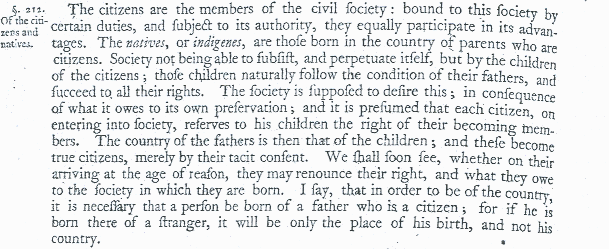
And the first American Edition (1787) issued the year of the Constitutional Convention also does not have “natural born citizen”.
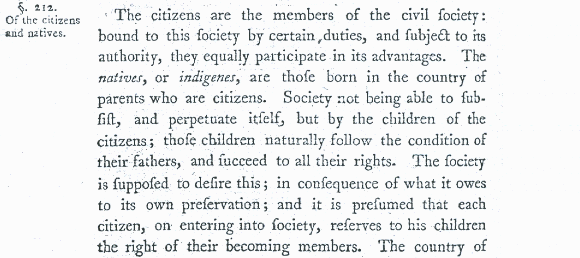
So I ask, how can de Vattel’s “The Law of Nations” define a term that it doesn’t even contain (except in translations a decade after the Constitution was ratified)? If the framers wanted to refer to de Vattel, then they surely would have used his words from the English translation they had, but “natives or indegenes” is not in Article II of the Constitution.




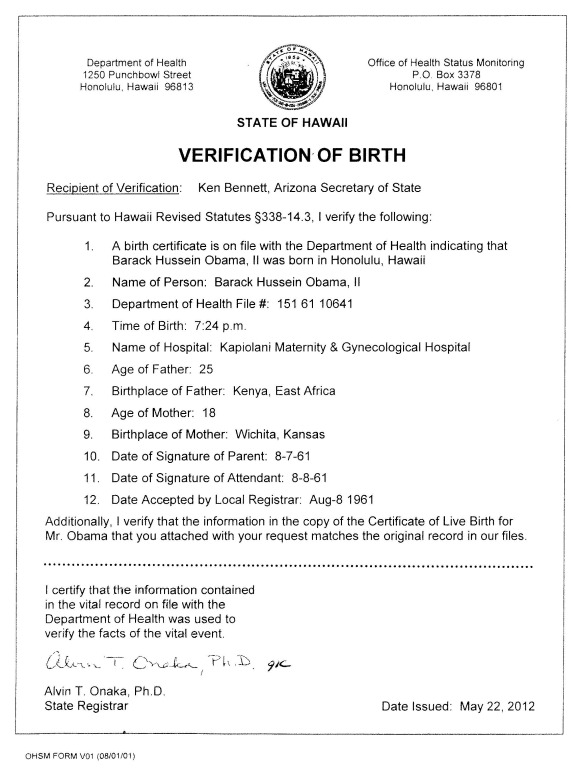

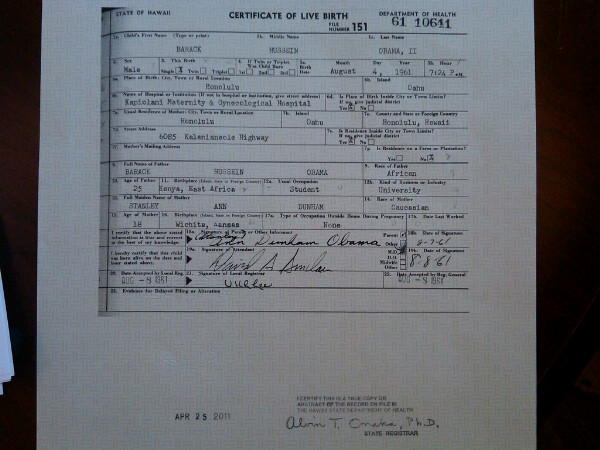
I would think the Framers would be familiar with the French version, as many of them were able to speak French.
A few strange things about Vattel. He may have defined a natural born citizen as those whose parents are citizens, but he did not make it clear that both must be citizens. He subsequently just said “father” must be a citizen (Apparently in those days women were not citizens).
Second, while Vattel apparently defined a natural born citizen, he never said that the chief executive, ruler, or sovereign of a country should be a citizen–natural or other. He cites several kings and emperors who were from foreign countries, and never disapproves or says that if they had been citizens it would have been better.
And, the Constitution did not always follow Vattel’s advice. For example, he recommends that countries create state religions, but we didn’t do that. In fact, in the Bill of Rights, we specifically forbid the establishment of a religion.
So, it is hard to prove that Vattel was influential.
De Vattel defined “Les Naturels ou indigènes”, not “natural born citizens”.
Something else about de Vattel’s definitions that has bothered me:
De Vattel (like most other “authorities”) acknowledges only two types of citizenship; by birth and by naturalization. Of course, his definitions of these categories are unique. For example, he asserts that British Common Law does not actually grant “citizenship by birth” to the children of foreigners born there, instead it “naturalizes” them at birth.
If we are to accept the claimed de Vattel definition that depends on jus sanguinis, then the children of foreigners born on US soil would actually not be citizens at all, let alone “natural born.” This actually causes a significant problem for many (possibly most?) current Americans.
For example: I am the grandson of immigrants. My grandfather eventually naturalized, but not until after my father’s birth on American soil. This would render my father a non-citizen at birth.
Since my father never naturalized, that would also render me a non-citizen at birth. And of course, all my (and my father’s) descendants as well… unless one of them should for some strange reason decide to formally naturalize.
How many Americans are likely to find a similar circumstance in their family trees? It only takes one to start the ball rolling.
Now, my point is rendered moot by the 14th Amendment, I know. But not all nations have a 14th Amendment, and de Vattel was not writing about the US (it didn’t even exist when he wrote). De Vattel’s definition (as understood by the Birthers) is actually a massive intellectual brain fart; impossible and unworkable in practice. It would likely disenfranchise a huge population entirely by accident and be massively disruptive to the “Laws of Nations.”
Of course I write this as a second generation usurper of “natural born citizen” status.
Dr. C., have you seen the 1789 edition? I was not aware there was one. A law professor friend told me the earliest addition their law librarian could find with the phrase was in the 1790’s. The language in the earlier english additions was “The natives or indigenes are those born in the country of parents who are citizens.” This was the language cited by the Supreme Court in 1814 (in The Venus) and in Lynch v. Clarke in 1844.
In defense of de Vattel, later on he acknowledges that in practice, countries have different laws on citizenship which must be followed.
This just goes to point out that “natural law” is not always practical.
See this link for a more in depth look at the translations
Yes, the 1789 edition is on Google Books:
http://books.google.com/books?id=z8b8rrzRc7AC
Am most in your debt for reminding me of this page, and for many other informative remarks in the past.
This is a good example of what you see nObama’s say (comment from Apuzzo’s blog):
This all evaporates, now that we know the words “natural born citizen” were not in the copy of de Vattel’s book available to the framers. The argument turns to vapor and blows away.
Am my missing something. Doesn’t that edition say 1797?
Dear Doctor Conspiracy,
It gets even worse for the Vattel worshippers. It is a simple matter to check and see how 18th Century French translations of the American Constitution immediately after it’s publishing, all the way up to present day French translations of our Constitution, all translate the Framer’s expression, “natural born citizen” into French in the same way, using the expression “citoyen de naissance” NOT the French expression Vattel used which you quoted above, “Les Naturels ou indigènes”. So the French words for “natural Born citizen” were available but not used by Vattel. Apuzzo knows this translational Achilles Heel exists in his argument, and I believe he recently felt conpelled to leave open the possibility that perhaps experts in 18th Century French/English translation might need to be consulted to more reliably settle that question. Which leads me to wonder why Apuzzo hasn’t verified this himself with such translators, given Apuzzo’s attention to every other detail? I interpret his hesitation to mean that he HAS researched what the wording of the French original would have had to be to yeild “natural born citizen” in English” and in so doing has seen “the writing on the wall” and knows it doesn’t spell out in English ” natural born citizen”!
Benji
Given Apuzzo’s prior shift from birther to citizenship denier, I would assume he saw the handwriting on the other wall some time ago.
Doooooooooooooooooooomed ❗
Excellent work, Doctor C.!!!
I take very little credit.
Ballantine planted the seed. I asked the question. Greschak found the old images. NBC reminded me of where I saw them before. I just wrote the article. Frankly, if I hadn’t been so dense, I would have had this 2 months ago.
It is not too difficult to find out how to translate “Natural born citizen” into French NOW (http://dsp-psd.tpsgc.gc.ca/Collection-R/LoPBdP/BP/bp445-f.htm). Note that “citoyen par naissance” is also sometimes used (http://www.admin.ch/ch/f/rs/0_353_915_4/a3.html). I believe you when you say it was translated in the same way (or ways) between 1776 and 1800 (the Code Napoleon went for “ius sanguinis”, muddying the waters a bit, temporarily), but do you have evidence for that assertion? It would indeed destroy the entire argument.
I don’t see how at any time you could literally translate the French “Les Naturels ou indegenes” (plus accent marks) into “natural born citizens”, i.e., create the word “citizens” when it simply isn’t there. If it’s not a literal translation, then it cannot be a dictionary-like definition used by the framers. That is, the entire argument is destroyed.
The Obot side has to work slower because we are bound by the truth and can’t just make stuff up.
Dear Paul,
Stay tuned – I’ve seen the pre-1800 French text myself – but not recently enough to remember the cite (pre-Obama controversy.) I’ll try some academics in the U.K. who specialize in this stuff and see if I can come back here with some multiple cites for everybody. Couple weeks or so?
You do good work, Doctor Con!
Benji
Doc I was pleasantly surprised to see you engage the birther egomaniac “Trip” on Hannity forums this morning, haven’t been following the thread lately but it should be fun now, good luck with Trip because he will be a tough nut to crack…he has about 3 or 4 disciples in that thread that absolutely adore him but you have an equal number quite capable of backing you up as well. I am banned from posting in that thread btw.
http://forums.hannity.com/showthread.php?t=1216821&page=1213
Well I didn’t give them very much to work with.
Well I’m sure he will reply to your post sooner or later, Trip needs to be brought down a notch or two and you’re the one who can do it doc!☺
Hey doc it appears you are a threat to ‘ol Trip, his report to the mods seems to indicate he thinks there is something suspicious about you….he doesn’t like his applecart being upset doncha know!
http://forums.hannity.com/showthread.php?t=1464761
I’m surprised that he isn’t demanding to see my birth certificate.
Thanks for the terrific debunking of an often used birther talking point – Vattel.
Greshak appears to have gone to a great deal of trouble to find older translations of Vattel. Indeed, the versions Greshak found published before 1787 did not use the phrase “natural born citizen.” So we can be sure the founders did not use a definition found in any of those translations.
Its highly unlikely that another translation was in circulation at that time. Greshak obviously long toiled to find any. However, I have a speck of uncertainty because of the history studying skills of Greshak.
Elsewhere in his essay, Greshak admits he can’t find a dictionary older than 1828. Throughout his essay, where he quotes text written in the old English form with the funny looking S he substitutes an F, such as in writing “fociety.” My guess is Greshak hasn’t read enough older documents to realize that the character he is viewing is an S.
I don’t agree with your advice that Greshak is worth studying. His conclusion, that the birther definition of “natural born citizen” is correct is not supported by his evidence.
Greshak doesn’t seem to understand that legal documents that are drafted by or with the assistance of lawyers use established legal definitions for their terms. Rather than look at old cases or trying to discover the legal history of the phrase “natural born citizen,” Gershak first explores the use of the phrase in an old work on elocution, which has nothing to do with citizenship or a legal definition of the phrase.
He then goes on with the translations you cite, but seems unable to comprehend that he has dismantled his own argument in the process. Most of the rest of the essay is a painfully long analysis by incomprehensible megadeductions Greshak created after reading a modern Merriam-Webster’s dictionary.
For me, I’ll keep as the most probable account of the Vattel book’s history Greshak supplied. Other than that, I don’t think he’s worth reading.
I notice that some ‘birthers’ look to the The Venus 1814 Supreme Court as justification for dragging Vattel into the argument.
Looking at this closer two things strike me:
the case is a true ‘law of nations’ case – whether a captured ship is a lawful prize – rather than a purely domestic case interpreting the US constitution;
in his opinion C.J. Marshall quotes extensively from Vattel but rather than ‘..natives, natural born citizens…’ his quotes use the older ‘…natives or indigenes’.
It seems that 27 years after the constitution the association of Vattel and ‘natural born’ still wasn’t all that ‘natural’ to the highest ranking lawyers in the land.
By the way, does anyone know who translated the 1797 edition? I’ve seen an attribution to Joseph Chitty which is just about possible but reading Chitty’s preface to his 1833 edition I think the attribution may be wrong.
Also, Marshall wrote a concurring opinion (only one other justice signed onto it). Most birfers leave that fact out (although Apuzzo, to his credit, did duly note this in his opposition’s citation of The Venus.)
Greshak’s conclusion is exactly what the 1797 translation states. Greshak says in a long and thorough analysis that ‘indigenes’ = natural born citizen. Right? So, what’s the problem with relying on the 1797 translation of de Vattel? I don’t see why you equate that with a hoax. Just as Greshak suggests an amendment to clarify ‘born exclusively of Citizens’ (plural); that is the entire problem wrapped up in a few words.
Greshak’s conclusion:
“As I have shown here, the definition of the phrase natural born Citizen of the United States that I have put forward in this essay is a relatively direct consequence of American English and the essential nature of the United States, including the United States Constitution. Still, I believe it would be beneficial to have the phrases native born Citizen of the United States and natural born Citizen of the United States defined explicitly in the Constitution in a new amendment (the Natural Born Citizen Amendment). Also, the fact that one must be domiciled in the United States, to be considered a Citizen of the United States, could be stated there, as well. Here is a draft for such an amendment:
Proposed Natural Born Citizen Amendment to the United States Constitution.
No person shall be a Citizen of the United States who is not domiciled, either by choice or dependency, in the United States. A native born Citizen of the United States is a person who was born in the United States, and has been, since birth, a Citizen of the United States. A natural born Citizen of the United States is a native born Citizen of the United States, born exclusively of Citizens of the United States. A naturalized Citizen of the United States is a Citizen of the United States who is not a natural born Citizen of the United States.”
It can’t be cited as support to show the intent of the drafters of the US Constitution, because the US Constitution was drafted in 1787.
I agree that Greshak’s analysis is long and I agree that it is thorough. But I do not agree that his conclusions follow logically from his long and thorough analysis. Greshak relies on the common use of language, not the legal use of language, and to the extent that his conclusions follow from the evidence at all, they follow from the wrong evidence. Many of the framers of the Constitution were lawyers, and key ones (e.g. John Rutledge) were English trained. They lived and breathed English Common Law, and the U. S. Supreme court has said that the Constitution is written in the language of English Common Law (Smith v. Alabama).
Greshak himself published naturalization acts from Massachusetts that use the phrase “natural born”, all of which refer to residence, and none to parentage.
When looking at Greshak, and Apuzzo, and Taitz and Berg, and P. A. Madison, and the rest of that crowd, I am reminded of this phrase from the Bible:
I can’t speak for the Doc on why he used the term ‘hoax’ but if anything he’s being a little kind to birthers.
Usually when Vattel is being used to challenge President Obama’s eligibility they simply to refer to Vettal, usually quote a publication date of 1758 or 1759, and then the 1797 translation is quoted as if it was the original edition. If I recall correctly this has even been done even in some of the complaints to the courts. Given the birthers’ serious aim of deposing a President of the United States ‘hoax’ is a little mild – ‘fraud’ is much more accurate.
As for Greshak he’s clearly put a lot of work into his essay and I’m certainly grateful for his quotes from the various editions of Vettal,but to come to any sort of authoritative conclusion from the sort of analyis he’s done he’d have to be an expert in 18th century law and language which he’s not.
Whether there should be a constitutional convention to define ‘Natural born citizen’ is of course a political question but I’d suggest since the majority seem to regard President Obama as ‘natural born’ and for many years there’s been a small lobby for opening the presidency to all citizens I doubt if an any amendment would go the way you want.
Concerning your claim: ” born exclusively of Citizens’ (plural) “. The French language has a funny characteristic, which it shares with most Romance languages: once you begin a sentence in the plural (Les citoyens) you have to continue in the plural. So, in French, people do not have one heart, they have “heartS”. There is no “straight” way of knowing whether Vattel in that sentence meant “parents” or “un parent”. You do know that as far as citizenship is concerned, US women had equal rights to men in 1961, right?
Note that later in the paragraph, Vattel switches to “péres” (older spelling of pères)- fathers (note again: plural, as normal in French). I have long wondered why he made that switch. Did he want to include the possibility of a matriarchal society at the beginning of his elocution, and then switch to the more specific case of his home land Switzerland? If true, that would mean that he did indeed mean “UN parent” was sufficient. But it is probably far-fetched and there is a much more simple solution.
I think I know now why he wrote “parens” at the start. IT DOES NOT MEAN PARENTS! (yes, shouting like a real birfer, and the whole word “parents” in capital letters). It means relatives! In those days, when mortality was higher and Switzerland was sending its young men abroad to fight in foreign armies, it was normal for grandfathers, uncles and older cousins and brothers to act as fathers (grandmothers, aunts, sisters and mothers were legally chattel anyway).
http://www.wordreference.com/fren/parents does not give “relatives” as a possible English translation, but the expressions mentioned (amis et parents -> kith and kin, hommes parents -> menfolk, parents éloignés -> distant relatives) give you a good idea. Please check the link on “vague” too. Wordreference is, of course, a bit like Wikipedia: not 100% trustable. But those who can read French may have a look here:
http://books.google.be/books?id=q4oSAAAAIAAJ&pg=PA344&lpg=PA344&dq=%22les+parents%22+dictionnaire&source=bl&ots=UtJlE0SblA&sig=zx_nHk9ZLY_2wHxSW4ivodjkRoA&hl=nl&ei=zEN0SrGzNMnPjAeBzOWnBg&sa=X&oi=book_result&ct=result&resnum=3#v=onepage&q=%22les%20parents%22%20dictionnaire&f=false
So, even the older translations of Vattel are not completely correct, and should be amended to make them faithful to the original (and, coincidentally, free of misinterpretation by birtherdom). Vattel was not a birfer.
What is interesting is to compare Emerich de Vattel with Edward Lord Coke. Both derived concepts of citizenship from natural law, but arrived at different conclusions. De Vattel believed nature made allegiance something inherited from one’s father (as it was in Swiss society) where Coke (Calvin’s Case 1608) said that allegiance was created when one was born under the protection of one’s lord.
De Vattel’s analysis formed the basis of Swiss common law, including the rule of the 13 Swiss colonies of Swiss North America.Coke’s analysis formed the basis of British common law for nearly 300 years, including the rule of the 13 British colonies of British North America.“It can’t be cited as support to show the intent of the drafters of the US Constitution, because the US Constitution was drafted in 1787.”
Why not? Greshak’s very thorough, well documented, and step by step research shows that ‘natural born citizen’ is the same meaning as the word that was in print in 1787, ‘indigenes’. Why would the framers of the U.S. Constitution use a French word in Article II? It is only logical that they would use the correct English language translation of such.
The problem with Greshak’s meandering connection of the dots is that he takes a linquistic path rather than a legal path. Many of the Framers were lawyers, and some of those educated in England itself. It makes no sense that they would abandon both English common law and the existing colonial laws in favor of some Swiss philosopher.
If you think, for example, the phrase “natural-born citizen” in the Constitution originated with John Jay, do you think he read de Vattel in the French or in the English (if he read it at all)? According to The Founding Fathers and the French Language, by Paul M. Spurlin © 1976 National Federation of Modern Language Teachers Associations, John Jay “understood and spoke French, with great difficulty.”
The courts have already decided (Smith v. Alabama) that the Constitution is written in the language of English common Law:
Oh. I guess I missed your point then. Why did you point out Greshak in your original article post — “[Mr. Greshak has a more complete treatment of the phrase “natural born citizen” in history that is worth consideration. The serious student of this question would do well to follow the link and read the argument there.]” — but not say that ‘this work, although incorrect, proves the Vattel argument is a hoax.’ That would have been self-contradicting?
I don’t think Greshak proves the Vattel point a hoax as the title of your article implies. I think it supports that ‘natural born citizen’ is the correct translation of ‘indigenes’.
As far as the framers living and breathing English Common Law, I beg to differ. They knew the law. But the English Common Law was a contradiction to the nature of the right to rebel.
The following is a quote from Vic Battaile who is preparing a book on this topic, so I defer to his expertise. He has also published some articles explaining this at
http://papers.ssrn.com/sol3/papers.cfm?abstract_id=1442203
and
http://papers.ssrn.com/sol3/Delivery.cfm/SSRN_ID1442203_code1293585.pdf?abstractid=1442203
The quote from Battaile
“As matter of American history, some States retained certain aspects of British Common Law for their own purposes, but overall, British Common Law did not “continue to prevail” at the Federal level. Why U.S. v. Wong Kim Ark Can Never Be Considered Settled Birthright Law; see also discussion of Wong Kim Ark in Amicus Curiae Brief in Hamdi v. Rumsfeld. http://federalistblog.us/2008/11/natural-born_citizen_defined.html , http://federalistblog.us/2006/12/us_v_wong_kim_ark_can_never_be_considered.html
“In a recent speech to the Federalist Society, Supreme Court Justice Antonin Scalia confirmed that British Common Law had little, if any, “control” in the USA after the USA gained its independence from Great Britain: The common law is gone. The federal courts never applied the common law and even in the state courts it’s codified now. (Audio/Video: Justice Scalia speech, Nov 22, 2008)”
This question (clarification of ‘natural born citizen’ as written in Article II) has never been before the Supreme Court. I don’t agree that an amendment is needed. Article II speaks for itself. The framers did not write it lightly. They wrote exactly what they meant.
I don’t know Greshak’s biography, he may be more knowledgeable about language than I am.
So, if Greshak’s conclusion is not authoritative, and if using Vattel of 1758 ‘indigenes’ translated in 1797 to English language is fraudulent, then what is the correct translation of indigenes?
vattel does not matter. It’s Common Law which at the signing of the Constitution was based on English Common law.
SCOTUS in Wong Kim Ark laid that issue finally to rest.
Yes, in 1961… equal rights. At the time Article II of the Constitution was written, women and minors had the citizenship of the husband, father, by default. In 1961 women had individual citizenship, so the most favorable possibility is dual citizenship, which is exactly the divided loyalty, the split allegiance at birth, against which the framers of the U.S. Constitution attempted protection.
Do you mean this part, switch to ‘father’, “I say, that, in order to be of the country, it is necessary that a person be born of a father who is a citizen; for if he is born there of a foreigner, it will be only the place of his birth, and not his country.”
[Emmerich de Vattel, Law of Nations, 1758 AD, Book 1, Chapter 19 §212. Citizens and natives]
Nonsense. If you’re going to do that many twists and turns, it is obvious you are reaching for the answer you want.
What is the faithful translation? Why did the framers say natural born citizen, not native born citizen, not naturalized citizen, and not just simply ‘citizen’?
Dr. Conspiracy,
I see you have gotten religious lately.
I also see that you are fond of Coke and I of Vattel. Could you provide me one case or more wherein the Court defines what a “natural born Citizen” (not just a “citizen”) is by referring to Coke and his definitions (or any other English common law authority). I do have several cases in which the Court does refer to and cites Vattel directly and his definition of what “natives” or “indigenes” or “natural born citizens” (all three distinguished from an ordinary “citizen”) are or just gives his definition thereof in defining those words. I have cited some of these cases in my opposition brief to Obamas’s and Congress’s motion to dismiss my complaint/petition.
I do hope that you will take me up on my challenge.
Mario Apuzzo, Esq.
Of course not simply “citizen”, since they clearly wanted to exclude naturalized citizens. Why did they say “natural born” instead of “native born”? Probably because they were thinking of British common law and it’s phrase “natural born subject”.
Well Google translator says that it’s “indigenous”. Duh.
Greshak is a mathematician and an artist (if memory serves me right). He has no background in 18th century law or language.
“My point” is to educate folks and to provide a fair and balanced presentation. I do not agree with Greshak’s conclusions, but I want people to be aware of them. Greshak is the only person writing on the subject that I think makes any sense at all and that treats his sources with any degree of honesty. I also thought it highly unfair to use the images that Greshak uncovered and not share the fact that he uses those images as part of an argument that does not agree with my conclusions. Greshak is not part of the hoax (those who simply say that de Vattel wrote “natural born citizen” (in English translation) and the Framers read it, or that the term is “defined” in The Law of Nations).
The point in Wong is not that common law controls, so much as the undisputed fact that the legal terms in the Constitution are defined by the common law. But if we were to discard the common law, we would see in colonial laws and charters the same notion of citizenship that makes citizens of those born in the colony/state/country. Let anyone show me a colonial or state law that only grants citizenship to the children of citizens! The invitation is open. I’m waiting.
Mr. Apuzzo, wouldn’t the framers, all being of English descent, and most lawyers, have more relied on commentaries from William Blackstone written in 1765 rather than De Vattel, an obscure Swiss philospher?
Here is Blackstone’s classic exposition in 1765 of the legal meaning of the term from the Commentaries on the Laws of England.
William Blackstone, Commentaries 1: 354 361–62
“Natural-born subjects are such as are born within the dominions of the crown of England, that is, within the ligeance, or as it is generally called, the allegiance of the king; and aliens, such as are born out of it…all children, born out of the king’s ligeance [i.e on foreign soil], whose fatherswere natural-born subjects, are now natural-born subjects themselves, to all intents and purposes, without any exception; unless their said fathers were attainted, or banished beyond sea, for high treason; or were then in the service of a prince at enmity with Great Britain.” [The italics are Blackstone’s]
Blackstone explicitly grounds natural-born status on location (jus soli), not parentage, except when the child is born abroad. The notion that both parents have to be citizens is false. All children born on American soil are natural-born subjects or citizens. If Obama was born on American soil there would be no controversy. If he was born on foreign soil, the fact that his father was not an American citizen would disqualify him from natural-born citizenship.”
Blackstone is cited the majority in Wong Kim Ark. The dissent cites de Vattel.
The decision in Wong Kim Ark does not say that Wong Kim Ark, even citing Blackstone, is a natural born citizen. It states that the main question is Wong Kim Ark’s citizenship. The outcome of the case says that Wong Kim Ark is as much a citizen as the natural born child of a citizen.
The decision doesn’t say Wong Kim Ark is as much a naturalized citizen as another.
It doesn’t say Wong Kim Ark is as much a native born citizen as another.
It doesn’t say Wong Kim Ark is as much a natural born citizen as the natural born child of a citizen.
It says Wong Kim Ark is as much a citizen as the natural born child of a citizen.
Certainly, then, there must be a difference.
If I say that 4 five dollar bills is as much $20 as 2 ten dollar bills, are they equivalent?
Even the dissent, when reading the opinion in Wong Kim Ark, thought they were deciding the issue of natural-born citizen:
“And it is this rule, [the rule that parent’s alienage is irrelevant] pure and simple, which it is asserted determined citizenship of the United States during the entire period prior to the passage of the act of April 9, 1866, and the ratification of the Fourteenth Amendment, and governed the meaning of the words “citizen of the United States” and “natural-born citizen” used in the Constitution as originally framed and adopted.”
Blackstone may have grounded natural born more on jus soli. But, did not the framers have many justified reasons for breaking from the English common law in their founding documents? They determined that the United States would have citizens, not have subjects, because the God given rights were above the monarchy rule.
And didn’t the United States go to war with Great Britain over this difference between subject and citizen in 1812?
I’m not saying the War of 1812 defines Article II. I’m just saying that they may not have held as closely to Blackstone as you suggest. Common law served the monarchy well, but some of the concepts of it were in direct contradiction to the law needed for a Republic. So, if they disagreed with the concept of ‘subject’ then they were likely to turn elsewhere.
This quote is from Constitution.org
http://www.constitution.org/vattel/vattel-01.htm
“This 1758 work by Swiss legal philosopher Emmerich de Vattel is of special importance to scholars of constitutional history and law, for it was read by many of the Founders of the United States of America, and informed their understanding of the principles of law which became established in the Constitution of 1787.”
The dissent recognizes that the majority’s rationale leads to the conclusion that a person born in the United States is a natural-born citizen; why can’t you?
Bob, I beg to differ. I read the dissent and I believe it is saying that is not true.
Greg,
The paragraph you quote from the dissent: correct me if I’m wrong, but doesn’t this particular passage “which it is asserted determined” lead up to the disagreement with that ‘assertion’?
The passage goes on to say “I submit that no such rule obtained during the period referred to, and that those words bore no such construction; that the act of April 9, 1866, expressed the contrary rule; that the fourteenth amendment prescribed the same rule as the act; and that, if that amendment bears the construction now put upon it, it imposed the English common-law rule on this country
for the first time,
and made it ‘absolute and unbending,’ just as Great Britain was being relieved from its inconveniences.
Obviously, where the constitution deals with common-law rights and uses common-law phraseology, its language should be read in the light of the common law; but when the question arises as to what constitutes citizenship of the nation, involving, as it does, international relations, and political as contradistinguished from civil status,
international principles must be considered;
and, unless the municipal law of England appears to have been affirmatively accepted,
it cannot be allowed to control in the matter of construction.”
So, I don’t agree with Bob, that the dissent in this case defined natural born citizen the way you suggest.
And when you say, “even the dissent”, you don’t mean in addition to the majority, do you? Here’s what the majority said was the main question in Wong Kim Ark:
“The evident intention, and the necessary effect, of the submission of this case to the decision of the court upon the facts agreed by the parties, were to present for determination the single question…whether a child born in the United States, of parents of Chinese descent, who, at the time of his birth, are subjects of the emperor of China, but have a permanent domicile and residence in the United States…becomes at the time of his birth a citizen of the United States.”
The majority Did Not lay out the question as ‘determination… whether… becomes… at the time of his birth a natural born citizen, or a native born citizen, or a citizen.’ Neither does the dissent bring the term ‘natural born citizen’ into the question before them.
The dissent in Wong Kim Ark begins their writing with:
“The proposition is that a child born in this country of parents who were not citizens […] is, from the moment of his birth, a citizen of the United States, by virtue of the first clause of the fourteenth amendment, any act of congress to the contrary notwithstanding.”
So why, Greg, do you conclude that the dissent ‘thought they were deciding the issue of natural-born citizen’?
Newton was very influential in physics. He also believed in alchemy.
Vattel was influential in international law. He also believed in jus sanguinis citizenship.
There is no evidence that physicists are swayed by Newton’s studies of alchemy and there is no evidence that our founders were swayed by Vattel’s study of citizenship.
The key cases of citizenship, in fact, consider very carefully Vattel’s conception of citizenship and reject it. Lynch v. Clarke spent several pages looking at the different “Vattelian” philosophers and found that they weren’t even consistent with each other, much less adopted by the US. In Wong Kim Ark, the issue was comprehensively briefed by the losing side.
From the dissent:
“Considering the circumstances surrounding the framing of the Constitution, I submit that it is unreasonable to conclude that “natural-born citizen” applied to everybody born within the geographical tract known as the United States, irrespective of circumstances, and that the children of foreigners, happening to be born to them while passing through the country, whether of royal parentage or not, or whether of the Mongolian, Malay or other race, were eligible to the Presidency, while children of our citizens, born abroad, were not.”
Justice Fuller writes this because he is critiquing the majority opinion. If the majority opinion didn’t lead to the conclusion that those born in the United States are natural-born citizens, there would be no need add this in.
I didn’t mean to imply that the dissent believed natural born citizenship was bestowed by birth.
The dissent believed the MAJORITY had passed on the issue of citizenship by birth. Why do I believe the dissent believes that of the majority decision? Because they write as much.
“The English common law rule, which it is insisted was in force after the Declaration of Independence, was that [people born in the country were natural-born subjects] The tie which bound the child to the Crown was indissoluble. The nationality of his parents had no bearing on his nationality. Though born during a temporary stay of a few days, the child was irretrievably a British subject. … And it is this rule, pure and simple, which it is asserted determined citizenship of the United States during the entire period prior to the passage of the act of April 9, 1866, and the ratification of the Fourteenth Amendment, and governed the meaning of the words ‘citizen of the United States’ and ‘natural-born citizen’ used in the Constitution as originally framed and adopted.”
Yes, the dissent then goes on to argue that such a rule was NOT appropriate. But, the dissent LOST!
The dissent was written by the Chief Justice and was joined by Justice Harlan. Clearly, these are no legal dimwits. They read the same opinion by Gray that I have read. They concluded that the majority opinion decided the issue of natural-born citizenship!
Most of the framers of the Constitution were farmers and landowners. And they were “birthers,” thus the distinction between a citizen at the time of the adoption of the Constitution or a Natural Born Citizen.
Sven says: “Most of the framers of the Constitution were farmers and landowners.”
Flapping his mouth making assertions that he doesn’t back up, thereby wasting precious electrons.
While I cannot speak for the entire Convention, I can speak for the delegates from South Carolina:
John Rutledge – Judge, Lawyer, Legal education in London, later governor of South Carolina
Charles Pinckney – lawyer, later governor of South Carolina
Charles Cotesworth Pinckney – lawyer, US Minister to France
Henry Laurens – Slave trader, landowner, President of Continental Congress
Pierce Butler – planter, served in Continental Congress and U.S. Senate
Calling them “birthers” is silly. The laws of South Carolina did not require parents for citizenship.
The Illuminati has deleted all my links. But I will say, unsupported by hyperlinks, that property rights is at the very root of the US Constitution.
Consequently, the framers of the Constitution insisted on a citizen of the land, a Natural Born Citizen, to be a basic requirment to hold the office after they qualified it with an exception for citizens at the time of adoption.
I think you are adding 2 to 3 and getting 7.
It is as simple as this. Yes ‘natural born’ was mentioned in the majority reasoning. The majority agreed with a pamphlet published by Binney that stated a person such as Wong Kim Ark ‘is as much a citizen as the natural born child of a citizen.’
Yes the dissent counters that argument.
But neither the majority nor the dissenting opinion stated the question as one of ‘natural born citizen’. Likewise, neither the majority nor the dissenting opinion stated the conclusion as an answer to ‘natural born citizen.’
Here is the majority question and conclusion in Wong Kim Ark.
“The evident intention, and the necessary effect, of the submission of this case […] to present for determination the single question, stated at the beginning of this opinion, namely, whether a child born in the United States, of parents [who are not citizens] becomes at the time of his birth a citizen of the United States. For the reasons above stated, this court is of opinion that the question must be answered in the affirmative.
“Order affirmed.”
Here is the dissenting opinion question:
“I cannot concur in the opinion and judgment of the court in this case.
“The proposition is that a child born in this country of parents who were not citizens of the United States, […] is, from the moment of his birth, a citizen of the United States, by virtue of the first clause of the fourteenth amendment, any act of congress to the contrary notwithstanding.”
And the dissenting opinion conclusion:
“In other words, the fourteenth amendment does not exclude from citizenship by birth children born in the United States of parents permanently located therein, and who might themselves become citizens; nor, on the other hand, does it arbitrarily make citizens of children born in the United States of parents who, according to the will of their native government and of this government, are and must remain aliens.
“Tested by this rule, Wong Kim Ark never became and is not a citizen of the United States, and the order of the district court should be reversed.”
You cannot extrapolate what isn’t there in black and white. You say that the dissenting judges thought the majority was defining ‘natural born citizen’ simply because it was mentioned and countered in the arguments.
If it isn’t there in black and white, in the questions, nor in the conclusions, your logic doesn’t add up.
Not only to hold office, but to vote. All that proves is that parent’s are not a requirement.
No one here is arguing the legal issue in Wong Kim Ark was whether he was a natural-born citizen. It is clear the more narrow issue at hand was whether he was a citizen.
Yet it is also clear from the majority’s application of English common law that if Wong Kim Ark was a citizen, he was also a natural-born citizen, as he wasn’t a naturalized citizen.
The dissent makes a not-unreasonable counterargument, which included dire warnings about the effect the majority’s opinion would have. But the dissent’s argument did not carry the day.
Which is why you’ll be hard pressed to find an actual legal scholar that will say natural-born citizenship requires two parents, as there’s no case that says that, and the born-in-United-States-is-sufficient rule is rather a easy extrapolation from the majority’s holding.
It’s a tradition Congress recesses in August. The August recess is not to check in with their law office. It’s to oversee the harvest.
Above all else, the framers of the Constitution were most concerned about property rights of landowners.
And don’t believe what you read on the net. It’s all lies.
And don’t believe what you read on the net. It’s all lies.
I’m sorry, I can’t believe that.
It’s right there in black and white.
The dissent says, “The majority says X” then the dissent argues against X.
You can argue that the dissent got it wrong when they interpreted what the majority said.
You cannot say they didn’t say “The majority says X,” when it is right there in black and white!
Oh bull. Harvest. Meh. The reason for recessing in August was to avoid August in DC without AC.
Dr. Conspiracy,
I take it that your group has found only the Wong Kim Ark and Lynch v. Clarke cases to support your position that the meaning of an Article II “natural born Citizen” comes from the English common law and not from Vattel. Again, I asked that the case make specific reference to “natural born Citizen” and not just “citizen” as the term it was defining under English common law. From thet results of your search, it seems that there is not much case law support for your position.
By the way, I do not understand why your group would think that Wong Kim Ark decided that Wong was a “natural born Citizen.” After all, Wong was not running for President and there was no need to decide his status in that connection. All Wong needed, like all other persons wanting to be a U.S. citizen, was to be a U.S. citizen. Being a citizen guaranteed that the Government could not refuse him entry into the U.S. or deport him therefrom. Being a “natural born Citizen” would not have given him any rights, privileges, or immunities that he needed. He surely did not need the “natural born Citizen” status, for he was not running for President.
I am sure that you are aware that the U.S. Supreme Court would never decide an issue that it did not have to decide, especially if it is a constitutional issue. Why would the Court decide that Wong was an Article II “natural born Citizen” when it was only being asked whether Wong was a 14th Amendment “citizen?” Why would the Court see a need to define “natural born Citizen” when the term does not appear in the 14th Amendment? The simple answer to these questions is that the Court only decided that Wong was a 14th Amendment “citizen” and did not decide that he was an Article II “natural born Citizen.”
Finally, whatever the dissent believed the majority decided does not change what the majority decided. The majority decision speaks for itself quite clearly.
Mario Apuzzo, Esq.
I take it that your group has found only the Wong Kim Ark and Lynch v. Clarke cases to support your position that the meaning of an Article II “natural born Citizen” comes from the English common law and not from Vattel.
But other than that, Mrs. Lincoln, how did you like the play?
Again, I asked that the case make specific reference to “natural born Citizen” and not just “citizen” as the term it was defining under English common law.
And Wong Kim Ark and Lynch do just that. A search function will help you locate the many uses of the words “natural” and “born” in those decisions.
From thet results of your search, it seems that there is not much case law support for your position.
Other than a rather explicit SCOTUS decision, and an oft cited state supreme court decision?
By the way, I do not understand why your group would think that Wong Kim Ark decided that Wong was a “natural born Citizen.”
No one here said that. Try reading for comprehension.
The simple answer to these questions is that the Court only decided that Wong was a 14th Amendment “citizen” and did not decide that he was an Article II “natural born Citizen.”
And a simple extrapolation of the majority’s reasoning leads to the conclusion that if Wong Kim Ark was a U.S. citizen, then Obama is a natural-born citizen.
Pity your case will be dismissed for lack of standing; but look on the bright side: you’ll never have a federal court telling you that you are wrong on this issue.
Take a look at Smith v. Alabama, Mario.
“The interpretation of the Constitution of the United States is necessarily influenced by the fact that its provisions are framed in the language of the English common law, and are to be read in the light of its history.”
So, my question to you. These guys were a bunch of lawyers, who were familiar with English Common Law. They had just fought a war with England, and most of the citizens, were at one time subjects of the English Crown.
My question to you: Why would the framers of the constitution abandon the more common definition of “Natural Born” and go with a Swiss philosopher? And furthermore, after going with this Swiss Philosopher, why would they not explicitly define “Natural Born” in the constitution, when they knew that the Blackstone Definition would be more widely known?
Now, for the final question. Do you have one case that backs up your statement that there are anything more than 2 types of citizens? Not just a case that you twist to state it, but one that discusses in depth how a Natural Born Citizen is different from a 14th Amendment Citizen? Please be specific.
And while we’re talking cases: Town of New Hartford v. Town of Canaan.
Mr. Apuzzo, Wong and Lynch are sweeping surveys of the history of citizenship in law and common law, and of course they are the ones we would cite most frequently. You and I both know that both Wong and Lynch cite dozens of other cases in arriving at their conclusions. And you and I also know that US V. Wong is the most cited case by courts in related immigration cases (including PERKINS V. ELG, 307 US 325, MORRISON V. CALIFORNIA, 291 US 82, ZARTARIAN V. BILLINGS, 204 US 170, CHIN BAK KAN V. UNITED STATES, 186 US 193, UNITED STATES V. SING TUCK OR DO, 194 US 161, JPMORGAN CHASE BANK v. TRAFFIC STREAM (BVI) INFRASTRUCTURE LTD. 536 U.S. 88, WEEDIN V. CHIN BOW, 274 US 657, ROGERS V. BELLEI, 401 US 815, TRUAX V. RAICH, 239 US 33, KWOCK JAN FAT V. WHITE, 253 US 454, AFROYIM V. RUSK, 387 US 253, HENNESSY V. RICHARDSON DRUG CO., 189 US 25, THE SAO VICENTE, 260 US 151, MONTANA V. KENNEDY, 366 US 308, TILLMAN V. WHEATON-HAVEN RECREATION ASSN., INC., 410 US 431, SOUTH CAROLINA V. UNITED STATES, 199 US 437, MICHIGAN V. MICHIGAN TRUST CO., 286 US 334, PEREZ V. BROWNELL, 356 US 44, MACKENZIE V. HARE, 239 US 299, etc. just to mention some of the Supreme Court cases, not to mention those from the lower courts).
This web site itself covers about a dozen other relevant cases, and the page referenced at the end of this comment contains massive support for my position. I realize that this site has hundreds of articles, and I would not expect you to know all of what’s here, but the fact of the matter is that Wong and Lynch are far from the only cases discussed on this web site that support my position.
Wong didn’t “decide” on the question of “natural born citizen” in just those words (nor did Lynch), but both cases discussed the heck out of those exact words. It would seem reasonable to me that should the natural born citizen question ever be adjudicated, the majority opinion would cite the same cases and authorities that the majority opinion in Wong did. Of course, if one accepts the general opinion of the matter, then Wong actually did decide the question, since “natural born citizen” means nothing more or less than “born a citizen”. It could hardly mean otherwise, lacking further definition in the Constitution. So when the Supreme Court decided that Wong was born a citizen, they decided that he was a natural born citizen — because it’s same thing.
But I would ask you a direct question: Assuming Barack Obama was born in Hawaii, do you agree that he was a citizen of the United States at the time of his birth?
If you would like more citations, go here:
http://www.obamaconspiracy.org/2009/01/the-great-mother-of-all-natural-born-citizen-quotation-pages/
I’ve added a few recently. Other articles here include:
MINOR V. HAPPERSETT, 88 U. S. 162 (1874)
United States v. Low Hong, Circuit Court of Appeals, Fifth Circuit.Circuit Court of Appeals (1919).
re Look Tin Sing
Town of New Hartford v. Town of Canaan, 5 A. 360 (Conn. 1886).
Regarding this artile. Indigenous still means natural born. the natural born phrase was chosen a few years after by a different translator but that doesn’t change the meaning. The new translation even supports the idea that indigenous was interchangable with natural born and natives during such time period. So it is not extreme to think that the framers adapted it themselves. The phrase is not taken from this book, but from Vattel’s concept of citizenship and the law of nations.
mrlqban: Indigenous [sic] still means natural born
That’s all very fanciful, but there are two gaping holes that let all the air out of your comment. First, you cite no authority that indigènes [you couldn’t even get it correct in the French] means “natural born”, and second you cite no authority that the framers of the Constitution used de Vattel’s concept.
So besides your own prejudices, I see nothing in your comment.
I was using logic to prove that indigenous (in English, I don’t want to use French)means natural born without citing.
If native = natural born (do you need authority for this?, it has been referenced in this blog a lot of times that they are equal)
,and indigenous = native, then indigenous must equal natural born.
For my last sentence, it is my opinion that the Framers possibly adapted Vattel’s concept. No different than your opinion that they possibly did not.
No, you are demonstrably wrong. The French Canadian version of “natural born” does not use indigènes. Why? Because “Indigènes” would imply the original inhabitants – Indians and (in Canada also) Inuit. In fact, if Vattel, an inhabitant of Switzerland (a country which has been afraid of being swamped by new arrivals from France, Germany or Italy) had been asked in 1776 what he meant with his phrase in the American context, the chance that he would have said only Red Indians, as naturels and indigènes were citizens, is slightly higher than 60%.
You could certainly make the case that all 44 US Presidents are illegitimate usurpers ruling over unjustly expropriated land.
well, indigenous in English or indigènes in French are synonym of natives no matter what language you use.
Pingback: THE Eligibility Thread (Birther etc) - Politics and Other Controversies -Democrats, Republicans, Libertarians, Conservatives, Liberals, Third Parties, Left-Wing, Right-Wing, Congress, President - Page 67 - City-Data Forum
Where did John Jay get the term natural born citizen?
DraggingCanoe: Where did John Jay get the term natural born citizen?
I know of no historical reference that directly tells us the answer. He did not get it from the English translation of The Law of Nations, because the phrase wasn’t there until years later. I’m pretty sure that I know where it came from, though.
The Naturalization Acts of New York from 1770 used the phrase “natural born subject” such as in the following:
a few years later after the Revolution we see similar language in a naturalization act of Massachusetts (1784):
It seems very likely that when the Colonies became States, and subjects became citizens, the form of the naturalization acts changed, replacing “subject” by “citizen”. It’s certain that the British Colonial language came from British common law. If indeed the States just substituted citizen for subject, then it is pretty certain that they retained the common law meaning. Jay, a lawyer, would have been familiar with the acts’ language. Lacking any other likely candidate, I think this is where Jay got the phrase.
A little research showing language immediately before and after the Revolution in the New York acts would nail this down pretty well.
Why do we translate “Droit des Gens” as “Law of Nations”? I don’t want to throw a toad in the gears here but this has been bugging me for some time. Surely it means “Rights of the People” doesn’t it? Is this significant? Are the phrases “Law of Nations” and “Droit des Gens” both idioms for something else?
We know the Founders seized a shipment of books bound for English prisoners. On the manifest are two different titled books by Vattel The shipment was seized in 1783. One has to wonder why were books in the French sent to English speaking people. Is it possible the books were in English?
Well, I can think of at least one other reason the Founders could not have used the 1860 version of Vattel…
DraggingCanoe: One has to wonder why were books in the French sent to English speaking people. Is it possible the books were in English?
You don’t get the point. It is not that Americans didn’t have English translations of The Law of Nations; they did. The point is that those translations didn’t say “natural born citizen.”
Prior to 1797, all English translations of The Law of Nations, including the 1787 American Edition all said “natives or indegenes” (italics in the original). It was not until the 1797 edition that the new translation used the words “natives or natural born citizens.”
Read the article again.
We have a letter from John Jay as President of Congress dated 1785 referencing Vattel as being the reason they made a decision.
He places a paragraph of Vattel in English in the letter.
What say you?
You have no proof John Jay did not obtain the idea of natural born citizen as being born from two US citizen parents from Vattel before the Constitution was ratified.
You stated the Founders would not use a Swiss national because the Founders were English. We know the Founders used Vattel to make decisions.
Dr Consp: “He did not get it from the English translation of The Law of Nations, because the phrase wasn’t there until years later. I’m pretty sure that I know where it came from, though.”
You really do not have any proof your statement. You do not know what was in the English copy the Founders used before the ratification of the Constitution.
You said the Founders would use the the thinking of Vattel, clearly they did.
They had a French copy and an English version.
You try to paint the Founders being English descent they would not know the French. They could read the classics in the original when they were boys.
You try to make them illiterate and make your God Obama a genius.
You know Obama is not a natural born citizen and in your zeal to defend him you slander the Founders as being stupid.
I submit you are a Fraud.
DraggingCanoe –
Do you have a reading comprehension problem? Did you even read what Dr. C has ever said on the matter?
No evidence exists that Vattel had anything to do with citizenship issues.
It has repeatedly been noted that Vattel was referenced in terms of international commerce by the Founders. There is no dispute or controversy on that. Nor is that relevant to the issues of citizenship.
All your image shows is evidence of what we’ve all been saying: Vattel was referenced in regards to international commerce -DUH!
Surely you are not too stupid to not know the difference between international commerce and citizenship?
You slander the Founders by making them, not stupid, but moronic – so mouth-breathingly dumb as to barely be able to tie their wigs on straight.
The Founders were smart people, many of them experienced lawyers. They knew that there was an English phrase, Natural Born Subject, which had been in use in England for 400 years. This same phrase, Natural born Subject, was used in the Constitutions and Charters of the colonies. The Founders quoted the case (Calvin’s Case) in which the phrase, Natural Born Subject, was defined (it gave us such golden-oldies as “Taxation without Representation,” remember that one?).
Despite there existing this phrase, Natural Born Subject, that everyone knew, that had been used by each of the colonies, and which formed the backbone of many of the legal arguments the Revolutionaries made in supporting the Revolution, you, Draggingcanoe, think they scrapped the meaning of natural born.
Now, here’s where it gets just outlandishly dumb – instead of choosing a different phrase than the one that was 400 years old, and in common use, natural born, according to you, the Founders used the same phrase, and expected that people would just get that they meant to refer to Vattel’s book.
EVEN THOUGH VATTEL’S BOOK WAS IN FRENCH AND NEVER SAID NATURAL BORN CITIZEN!
The Founders didn’t once say to themselves, “maybe we should use ‘indigenes,’ like Vattel did, if that’s what we mean?”
They didn’t once say, “Maybe if we use the same phrase, it will cause confusion?”
They didn’t once write down, “We mean ‘natural born citizen’ to be completely different from ‘natural born subject.’ We know it might cause confusion, but we really like that Vattel guy, and we’re sure that if he was translated right, he would have written it this way.”
In your world, the founders are complete imbeciles, aren’t they?
Personally, I think the founders were smart individuals who would have mentioned it to someone if they wanted to change a 400 year old phrase in common usage.
indigenes de ingenuis…u better google it..
Did you know that one sentence is the only time in Vattel’s book that indigenes is used?
In the next sentence, Vattel continues:
“The country of the fathers is therefore that of the children; and these become true citizens merely by their tacit consent.” In French, however, Vattel writes, “Le patrie des peres est donc celle des enfants; & ceut-ci devienment de veritables citoyens par leur simple consentement tacite.”
Interestingly, if one looks at the citizenship law of France from the time, one finds:
The true and natural French citizens are those born within the French dominion.
Citoyen = Citizen. It is clear in Vattel that that is what he was using, and it is clear in contemporaneous French law that citoyen is the word one uses when talking about citizens.
Now, here’s the question for you, Canoe. The British had been using natural born subject since 1350. Natural Born Subject was common in the colonial charters. The Founders cited the seminal case about Natural Born Subjects, Calvin’s Case, to make their argument for independence. And Vattel’s book used the phrase “indigenes,” and not “natural born citizen” until years after the Constitution was written.
Why did the Founders use the phrase Natural Born Citizen instead of saying “Indigenes,” or “Indigenous?”
Were they too stupid to see a similarity between the phrases Natural Born Subject and Natural Born Citizen?
I mean, it’s not like Obots were the first to notice this similarity, Canoe. By 1803, St. George Tucker was writing that Natural Born Citizen meant the same as Natural Born Subject – born here without regard to parentage. By 1829, William Rawle wrote, “Therefore every person born within the United States, its territories or districts, whether the parents are citizens or aliens, is a natural born citizen in the sense of the Constitution, and entitled to all the rights and privileges appertaining to that capacity.”
So, Canoe, just how dumb do you think the Founders were?
“Vattel does not matter”
Are you saying the constitution is based on English Common Law?
No man is a fit arbitrator to his own cause..
Why are you responding to a post from 8 months ago? If you have a legitimate point to make, make it.
Otherwise, going to your way back machine to find posts you want to challenge when this discussion is still being beaten to death in current threads has got to be trolling.
What has arbitration to do with truth?
DraggingCanoe says:
No man is a fit arbitrator to his own cause.
I’m willing to be the arbitrator.
“Debate on the Constitution,” Library of America, two volumes, 2389 pages.
Number of references to Blackstone: 22
Number of references to Vattel: ZERO
Number of references to the common law: 30
Number of references to natural law: ZERO
On p. 353 Roger Mason states that the common law was “adopted by the respective acts forming the constitutions of the several states.”
On p. 356, the Virginia Independent Chronicle opines that if the Constitution were to be ratified “The people have every security of enjoying the benefits of the common law.”
P. 364, from The Norfolk and Portsmouth Journal: “So far as the people are now entitled to the benefit of the common law, they certaily will have a right to enjoy it under the new constitution…The principles of the common law, as they now apply, must surely always hereafter apply.”
Alexander Hamilton, discussing the role of the Supreme Court (p. 491); “The appellate jurisdiction of the supreme court will extend to causes determinable in different modes, some in the course of the COMMON LAW, and others in the course of the CIVIL LAW.” (CAPS in the original)
I could go on, but you get the point…well, probably not.
DraggingCanoe (R): Are you saying the constitution is based on English Common Law?
The terms used in the Constitution are defined by the English Common Law (Smith v. Alabama).
A common confusion. When terms are undefined in the Constitution, its meaning has to be found in common law.
Let’s not confuse the matters with foolish strawmen now shall we?
And yes, a lot of the principles of English Common Law were accepted into US Common Law.
Surprised? Why would the Founders throw away good law? Law which had served the colonies well.
“Les naturels, ou indigenes, font ceux qui font nés dans le pays, de parens citoyens.”
How the the Founders would translate naturels..is important.
The naturels or indigenes (natives). Citoyens is citizens. parens is parents.
We assume naturels is naturals, but how did the Founders translate the word naturels.
In the congressional record (1781) there is a translation of the word naturels..natural born.
The Founders understood the meaning of naturels to be natural born. The document translating naturels to natural born has been overlooked..but it is there in the record.
The natural born or natives are those who have citizen parents.
“Let us appeal to enlightened and disinterested judges. No one is more so than Vattel.” Jefferson
http://etext.lib.virginia.edu/etcbin/toccer-foley?id=JefCycl.xml&images=images/modeng&data=/texts/english/modeng/parsed&tag=public&part=9221&division=div2
“Vattel is one of the most zealous and constant advocates for the preservation of good faith in all our dealings” Jefferson
http://etext.lib.virginia.edu/etcbin/toccer-foley?id=JefCycl.xml&images=images/modeng&data=/texts/english/modeng/parsed&tag=public&part=9222&division=div2
It is reported by the editors of the 1797 English edition of the Law of Nations was translated by Thomas Nugent. (1770-1777). Nugent vistied the Colonies and published a French-English pocket dictionary.
http://oll.libertyfund.org/index.php?option=com_staticxt&staticfile=show.php%3Fperson=4221&Itemid=28
The 1928 Bouvier’s Law Dictionary defines natives as born to citizen parents.
Morse does the same.
“By the law of nature alone, children follow the condition of their fathers. Vattel; Morse, page 15.
“A legitimate child, wherever born, is a member of the nation of which its father at the time of birth was a member.” Field’s International Code, page 132; Morse page 17.
“Let a child be born within the walls of a church, this does not make him a church member.” Morse page 14.
“It is not, however, the spot of earth, upon which the child is born that connects him with the national society, but the relation of the child’s parents to that society.” A Treatise on Citizenship; Morse, page 13.
“The true bond which the child with the body politic is not the matter of an inanimate piece of land, but the moral relations of his parentage” Vattel, section 215-220. Morse, page 12.
http://www.archive.org/stream/cu31924020027870#page/n7/mode/2up
Context is really important and I think the little citation you left us is so badly out of context as to constitute fraud if intended to say that Field supports the nObama notion of two citizen parental requirement, because Field footnoted that section, saying:
and
Field also cites Ludlam v Ludlam that has a different view, and notes his view on the limitations on the application of Lynch v Clarke (limitations that future federal courts would not recognize).
This is why this web site exists, to prevent fraud.